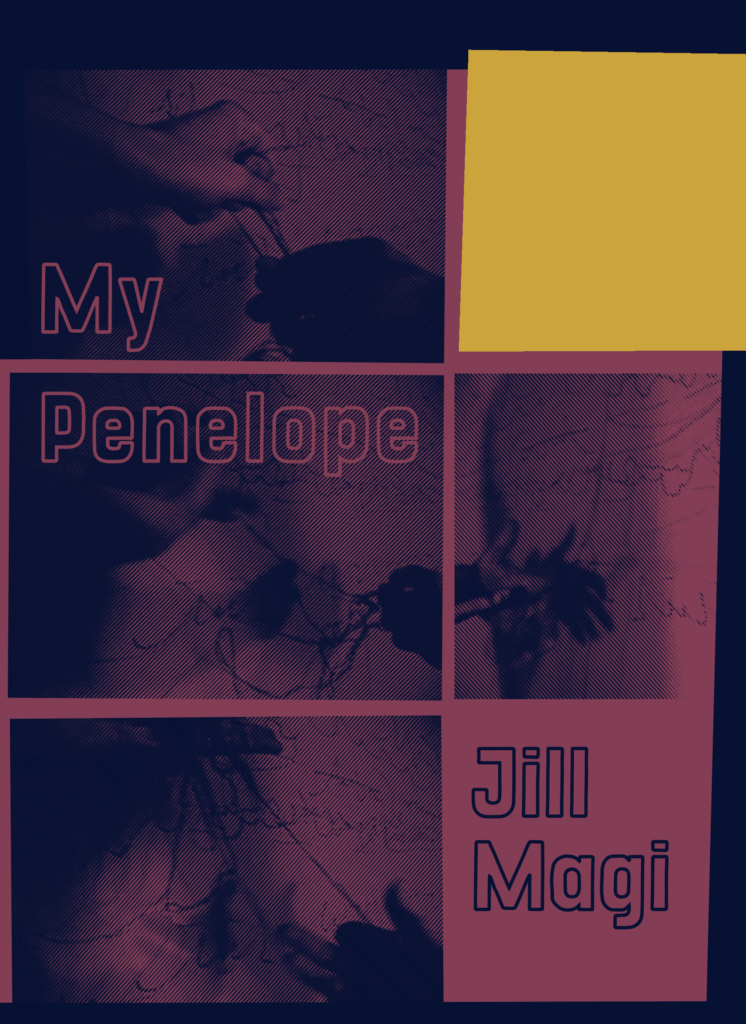
My Penelope
Jill Magi
March 1, 2026
A celebration of poetry and art, a critical look at art historical and literary categories, a view that takes in class, race, gender, the living and the dead all at once: this is My Penelope, whose sister publication, Hinge: Remember Me to Textiles (Nightboat Books, forthcoming), completes a capstone of Magi’s poetics. Beginning with nods to Penelope of Homer’s Odyssey and Susan Howe’s My Emily Dickinson, Jill Magi’s essays, like Penelope’s unweaving, create space/time for poets—poets who are all of us, whether or not we read or write—to make new life which is making a poem. Collected here are over twenty years of previously published book reviews, essays, and poems-as-essays. Down every avenue of experience and thought, and with every foothold and slippage, sometimes revisiting the same autobiographical and theoretical terrain with a new lens, these essays allow for poetry to lead life’s way. This is language as pliant material, favoring relationship over objecthood and movement over arrival.
In an essay on Gertrude Stein, Jill Magi asks “What might now be unseen in the living with these words that we are doing?” My Penelope pulls back the curtain and reveals the beating and beaten multi-chambered heart of class, race, and labor that pulses through the body of 20th and 21st century experimental poetries. It’s an expansive syllabus, an impassioned argument to get closer to poetry in order to survive these times.
— Jena Osman, author of Motion Studies
In My Penelope, poetry is a “technology of night,” a “tool of dismantling.” But for Magi, who is also a visual artist, “poetry” is a capacious word, inclusive of a jotted down thought, a word spoken in a classroom, a tag on a concrete wall, a gesture of the body. The “poem” is of necessity impure and orphaned, raveling and unraveling as it moves through and among us, a collective and crafty un-mastery, anarchic in its wild inclusivity as it remakes and re-marks the very terms of “value.” Read this fantastic book. And then: write/unwrite.
— Julie Carr, author of The Garden
Magi broadens the scope of what poetry is and who makes it. No material is unwelcome in her expansive act of defining as she explores the personal, political, pedagogical, literary, and historical. She invites the reader to see an object as writing, a sculpture, a pile of unraveled threads, dirt, actions, speech, and even silence. She expounds on how writing emerged from the human impulse to make a mark, and then guides the reader through a miscellany of studies where writing itself becomes the subject, defined through various acts of making, unmaking, and remaking. This definition is illustrated masterfully as it becomes both the content and the modality of the book.
— Francesca Capone, author of Weaving Language I-III
JILL MAGI works in text, image, and textile, and is the author of six books of poetry: Threads (Futurepoem 2007), Torchwood (Shearsman 2008), SLOT (Ugly Duckling Presse 2011), Cadastral Map (Shearsman 2011), LABOR (Nightboat 2014), and SPEECH (Nightboat Books 2019).
Her handmade books and chapbooks are collected by the University at Buffalo special collections library, and for her work running Sona Books, a community-based chapbook press, Jill was named as among the most influential authors in the world by Poets & Writers magazine in 2010. Jill is also the author of numerous critical and scholarly essays, selected and republished here by Essay Press in My Penelope. An extended meditation on textiles and textility, entitled Hinge: Remember Me to Textiles, is forthcoming from Nightboat Books.
Her visual work has been exhibited in solo shows at 421, Grey Noise, and Tashkeel galleries in the United Arab Emirates, as well as at the International Arts Center at Troy University, the Southern Vermont Arts Center, Flow Chart Foundation in Hudson New York, and the Project Space at New York University in Abu Dhabi. Jill was an artist-in-residence with the Brooklyn Textile Arts Center and a writer-in-residence with the Lower Manhattan Cultural Council Workspace program. An educator for over twenty-five years, Jill has worked in adult literacy programs, art schools, large research universities, and experimental colleges. She splits her time between Southern Vermont and Southeast Alabama, two locales that tell specific stories of settler colonialism, land use and occupation, labor and agriculture, degradation and persistent acts of liberation.